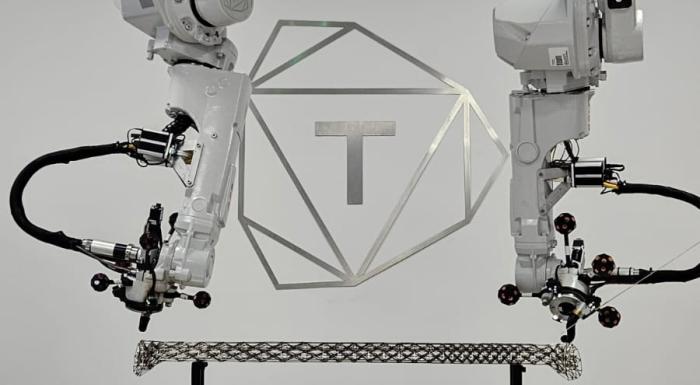
For deep tech company TETMET, the future of manufacturing is lightweight, efficient and increasingly autonomous. With its first industrial-scale factory at SEGRO Park Amsterdam Airport in Hoofddorp, the company is taking a major step from technological innovation towards large-scale production, with Amsterdam Airport City as the base for its next phase of growth.
TETMET develops a new manufacturing technology called Adaptive Spatial Lattice Manufacturing (ASLM), designed to produce lightweight, high-performance structural components while using significantly less material and energy. Its initial focus is on the space and defence sectors, where reducing weight without compromising performance is critical.
Rethinking how things are made
The idea behind TETMET started with a simple observation. Three-dimensional truss structures are among the most efficient ways of using material and can be found in bridges, cranes and even the Eiffel Tower (Paris). At smaller scales, however, assembling these structures traditionally becomes too complex and expensive.
TETMET set out to change that.
“Think of our technology a little like knitting a sweater, but then in three-dimensional space,” Tom Vroemen, CEO of TETMET explains.

ASLM occupies a new position between additive manufacturing and traditional automated production. Instead of repeatedly melting, forming or otherwise manipulating large amounts of material, TETMET works with simple materials and only manipulates a fraction of them during production.
According to TETMET, independent academic research indicates that the technology can use two orders of magnitude less energy and more than 40% less material compared with conventional and newer manufacturing methods such as additive manufacturing and composites.
The potential is particularly relevant for aerospace and other high-performance applications. TETMET says its technology can reduce the mass of structural components by between 40% and 60%. This is significant in industries where every kilogram affects energy consumption, range and performance. The company’s own technology proposition focuses on structural components for space, air, land and defence vehicles.
From deep tech innovation to industrial production
Opening the Hoofddorp facility represents an important transition for TETMET: moving technology out of the lab and into industrial-scale manufacturing.“Building new industrial deep tech is very hard in Europe’s low-risk appetite capital markets,” TETMET explains.
“With very limited capital, we have managed to spin out of the lab and into scale very quickly. It demonstrates how fast Western reindustrialisation can go.”Its new facility at Amsterdam Airport Business Park will house TETMET’s first series of industrial ASLM machines alongside offices for its vertically integrated operations.The company already has ambitious plans for the site. Over the next five years, it aims to increase capacity fivefold at its current premises, with further expansion possibilities.
Why Amsterdam Airport City?
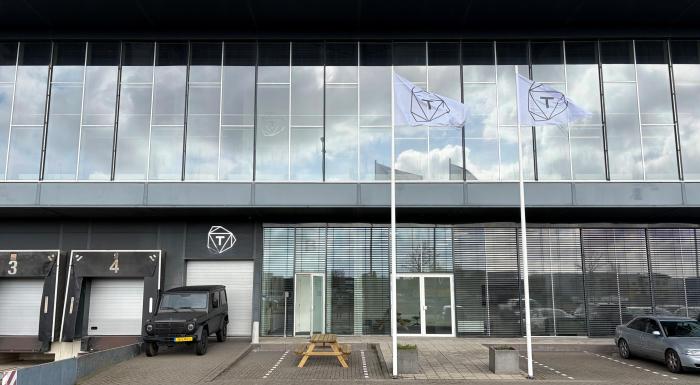
For TETMET, choosing Hoofddorp was closely connected to its international way of working.With teams in both Amsterdam and Paris, the high-speed rail connection enables frequent exchange between colleagues. At the same time, international customers and partners regularly fly into the Netherlands, making proximity to Amsterdam Airport Schiphol a practical advantage.“It is very important to be well connected through the airport and high-speed rail link, while still being adjacent to a metropolis that attracts talent.”
The building itself was another important factor. High ceilings provide the space required for TETMET’s manufacturing technology, while the office facilities allow engineering teams to work directly alongside production. The flexibility offered at the business park also provide room for the company to scale as demand increases. This combination of manufacturing space, international connectivity and access to talent makes Amsterdam Airport City particularly relevant for advanced manufacturing companies.
Building an ecosystem for deep tech
TETMET already has strong academic connections with Delft University of Technology and Eindhoven University of Technology, while key customer Stellantis also has its global headquarters nearby.
The company nevertheless sees opportunities to further strengthen the Dutch deep tech ecosystem. In particular, access to risk capital for industrial deep tech and affordable housing for international technical talent will be important if the Netherlands wants innovative companies to develop and scale locally rather than move abroad.
For TETMET, access to engineering talent is fundamental. Being close to an internationally attractive metropolitan region therefore matters just as much as having the physical space to manufacture.
Autonomous manufacturing
Looking ahead, TETMET sees automation, robotics and AI fundamentally changing industrial production.“The future of manufacturing is autonomous. The more automation, the fewer dependencies.”
Its Hoofddorp factory is an early demonstration of that ambition: combining advanced manufacturing with lower material use, reduced energy consumption and highly automated production.
And for other deep tech companies considering Amsterdam Airport City, TETMET has a clear message: “It may look like a logistics hub, but you’d be surprised how much large-scale deep tech is here.”